
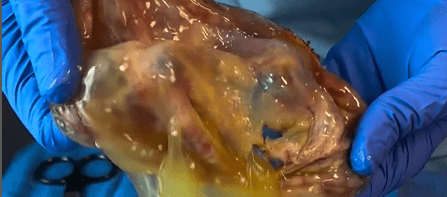
Despite decades of research, the exact cause of hairdressing contracture in silicone breast implants remains unclear, and many plastic surgeons struggle to explain this phenomenon. Often, hairstyle contracture is presented as a typical foreign body reaction, but the delayed manifestation . . . sometimes years after implantation . . indicates a more complex pathological process.
Hairdressing contracture occurs when the body forms a fibrous hairstyle around the implant that hardens and contracts, causing pain, aesthetic distortion and often explantation. Approximately 25% of the implants are removed due to this complication, which may occur shortly after implantation or after years. This is not a simple physiological reaction, but a chronic inflammation process, possibly driven by degradation of implant materials.
An underexposed factor is pyrogenic silica, a filler that accounts for 21,77% of the implant envelope and improves its strength and elasticity. Many plastic surgeons are not aware of the presence of pyrogenic silica, let alone its possible role in complications. Pyrogenic silica particles, which are not fully bound in the polydimethyl disregarded (PDMS) matrix, may migrate to aging, silicone bleed or ruptured.
Thebound rubber layer, in which PDMS anchors pyrogenic silica particles via adsorption and hydrogen bridges between silica particles, may weaken by oxidative or mechanical degradation. This can cause agglomeration of silica particles, which weakens the implant envelope and promotes microfractures, as suggested by a 16% thinner envelope after about 4 years (Bodin, 2015). This allows silica particles to loosen, which further impairs mechanical stability and can stimulate chronic inflammation.
These free silica particles can activate immune cells, especially macrophages, via signal paths such as Toll-like receptor (TLR) signaling, possibly via TLR4. This may lead to the release of pro-inflammatory cytokines (IL-1β, IL-6, TNF-α), which stimulate fibroblasts to produce collagen, which may contribute to fibrosis and hairstyle hardening. In addition, reactive silanol groups (nearly free silanols, NFS) may be exposed to silica particles, normally masked by surface treatment, at degradation, as suggested by yellow discoloration of explanted implants. Research shows that pyrogenic silica can be as harmful to macrophages as crystalline silica, which is classified by the IARC as carcinogenic, which underlines the toxicity of NFS. Sustained macrophage activation can create a self-enhancing ignition cycle, which could explain the delayed nature of hairstyle contracture.
The clinical implications are significant: chronic inflammation, possibly caused by pyrogenic silica, may worsen local symptoms such as pain and distortion and may cause systemic symptoms such as fatigue or autoimmune symptoms, as reported in some patients with silicone implants (also called Breast Implant Illness). Recent literature, such as the IOM study Safety of Silicone Breast Implants (p. 68) and the work of DeGroot and Macosko, suggests that pyrogenic silica could be a key cause, a hypothesis requiring urgent further research.
To reduce complications such as hairdressing contracture, improvements are needed, such as more stable surface treatments to minimize NFS, more durable envelopes to prevent degradation, and targeted research into the toxicity of pyrogenic silica in implants. By addressing these risk derivatives, silicone implants can be made safer.
Technical support
Pyrogenic silica: A high-risk filler
De envelop van siliconen borstimplantaten bestaat uit polydimethylsiloxaan (PDMS), versterkt met pyrogene silica (21–27% van de envelop). Silica verbetert de sterkte en elasticiteit, maar bij degradatie kan het ernstige complicaties veroorzaken. Vaak wordt gedacht dat amorfe silica in nanovorm minder toxisch is, maar onderzoek toont aan dat pyrogene silica net zo schadelijk kan zijn voor macrofagen (immuuncellen) als kristallijne silica, die door het IARC als kankerverwekkend is geclassificeerd. Dit maakt silica een zorgwekkende factor in implantaten, via twee mechanismen: bound rubber en nearly free silanols (NFS).
Bound Rubber: De fragiele basis van de envelop
Bound rubber is de laag PDMS die sterk gehecht is aan silica-deeltjes, waardoor de envelop stevig en elastisch blijft. Onderzoek, zoals dat van DeGroot and Macosko, benadrukt dat een stabiele bound rubber-laag silica-deeltjes verankert en voorkomt dat ze migreren binnen de envelop. Echter, bij veroudering gaat dit mis:
- Degradatie: Bodin (2015) vond dat de envelop na 4,25 jaar 16% dunner wordt, wat wijst op verzwakking van de PDMS-matrix en bound rubber. Dit kan microscheurtjes veroorzaken, waardoor silica-deeltjes losraken.
- Agglomeratie: Onbehandelde silica-deeltjes klonteren samen (filler-filler interacties), zoals recente studies aantonen, wat de envelop minder homogeen maakt en mechanische zwakte introduceert.
- Gevolgen: Een verzwakte envelop verhoogt de kans op gel bleed en migratie van silica-deeltjes, die macrofagen activeren en chronische ontstekingen, zoals kapselcontractuur, aanjagen.
Nearly Free Silanols (NFS): Een toxische dreiging
NFS zijn reactieve silanolgroepen (Si-OH) op silica-deeltjes die, volgens Pavan et al., ontstekingen en celschade veroorzaken door interacties met celmembranen. In implantaten zijn NFS normaal gemaskeerd door een oppervlaktebehandeling (het “ effect” met slechts 60% trimethylsilyl-dekking), maar degradatie maakt ze actief:
- Blootstelling: Gele verkleuring van explanteerde implantaten, zoals Bodin observeerde, kan wijzen op afbraak van de oppervlaktebehandeling, waardoor NFS worden blootgesteld.
- Hoge toxiciteit: Pyrogene silica’s vermogen om macrofagen te activeren, vergelijkbaar met kristallijne silica, maakt zelfs kleine hoeveelheden vrije silica-deeltjes gevaarlijk. NFS veroorzaken chronische ontstekingen, zoals granulomen, siliconomas, en kapselcontractuur, en mogelijk systemische klachten zoals Breast Implant Illness (BII).
- Cumulatieve impact: De late onset van kapselcontractuur suggereert dat continue blootstelling aan NFS, door degradatie en migratie, het kapsel pathologisch maakt.
Disclaimer:
The information on this website is intended for informational purposes and is based on carefully collected scientific research. The topics and hypotheses discussed have not yet been widely recognised within the medical community. We are not doctors and do not give medical or legal advice. No rights can be derived from the content of this website. Stichting SVS accepts no liability for any consequences, damage, complaints or legal proceedings arising from the use of this information.

