
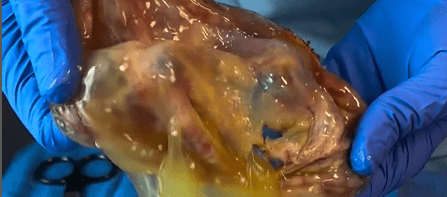
The IOM Study Safety of Silicone Breast Implants claims silica cannot migrate. DeGroot and Macosko, and other literature suggest that unbound pyrogenic silica particles and low-molecular siloxanes (such as cyclic/linear PDMS oligomers) may migrate from silicone breast implants, especially in aging, silicone bleed or rupture.
What exactly does this mean?
- “Free silica:
- Pyrogenic silica is added as a filler to the silicone envelope (and sometimes the gel) of breast implants to improve mechanical properties such as strength and elasticity. Although silica particles are ideally dispersed and anchored in the PDMS matrix, some particles can become "free," especially under certain conditions:
- Aging: Over time, the PDMS matrix can degrade due to mechanical stress, exposure to body fluids, or oxidative processes, which loosens silica particles in the matrix.
- Microfracture or rupture: If the envelope is damaged, silica particles can come out of the matrix.
- Incomplete binding: Not all silica particles are perfectly bound to the PDMS, especially if the surface treatment (such as the "umbrella effect" with TMS) is not fully effective or partially breaks down over time.
- These "free" silica particles can move within the implant or, in the event of a fracture, to surrounding tissues.
- Pyrogenic silica is added as a filler to the silicone envelope (and sometimes the gel) of breast implants to improve mechanical properties such as strength and elasticity. Although silica particles are ideally dispersed and anchored in the PDMS matrix, some particles can become "free," especially under certain conditions:
- Low molecular siloxanes:
- Low molecular siloxanes are small PDMS molecules (such as dimethicones or cyclosiloxanes, e.g. D4, D5) present in the silicone gel or envelope. These molecules have a low molecular weight and are more mobile than the long polymer chains of PDMS.
- Due to silicone bleed (diffusion of silicone through an intact envelope) or a rupture, these low molecular siloxanes can leak from the implant and migrate to surrounding tissues, such as the hairstyle, lymph nodes, or even further into the body.
- Simultaneous migration:
- In the event of aging or damage to the implant, free silica particles and low molecular siloxanes may migrate together. This is because:
- Mechanical degradation of the envelope or gel weakens the matrix, releasing both silica particles and liquid siloxanes.
- Silicone bled small amounts of siloxanes diffused through the envelope, whereby silica particles (especially nano- or microscale) can be "drag" if they are not well anchored.
- Rupture creates a direct path for both the gel (with siloxanes) and the filler (silica) to enter tissues.
- Studies, as mentioned in Safety of Silicone Breast Implants, show that silicone particles (including silica) are found in tissues outside the hairstyle in 86.6% of women with implants, suggesting that migration of both silica and siloxanes occurs.
- In the event of aging or damage to the implant, free silica particles and low molecular siloxanes may migrate together. This is because:
Relation to the "umbrella effect" and DeGroot and Macosko
- The "umbrella effect" (where 60% of the silica surface is covered with trimethylsilyl, TMS) helps to stabilize the dispersion of silica particles in the PDMS matrix by reducing the formation of bridging chains, as described by DeGroot and Macosko. This reduces the risk of migration of silica particles within the matrix during aging.
- However, the "umbrella effect" is not perfect:
- 60% coverage means that 40% of silanol groups (Si-OH) on the silica surface remains untreated, allowing any interaction with PDMS or body fluids. This may lead to the separation of silica particles over time.
- In the event of prolonged ageing or mechanical damage, surface treatment can be degraded, making silica particles more mobile.
- DeGroot and Macosko finding that bridging chains cause silica migration suggests that suboptimal surface treatment (or degradation) may contribute to the release of silica particles, especially in combination with diffusion of low molecular siloxanes.
Implications for breast implants
- Silicone bled: Even in intact implants, low molecular siloxanes diffuse through the envelope. If free silica particles are present (e.g. due to incomplete binding or degradation), these particles may move with the siloxanes to the hairstyle or further, which may cause local inflammation reactions.
- Rupture: A ruptured envelope releases both the silicone gel (with low molecular siloxanes) and silica particles, leading to tissue migration. This is a known cause of granulomas, siliconomas, or lymph node reactions.
- Health risk derivatives: Free silica particles, especially in nanoscale, can activate macrophages and cause inflammation There are concerns about long-term effects, such as with Breast Implant Illness (BII) or autoimmune reactions, although there is no definitive evidence for this.
- Aging: As implants age (on average 10 January 2010 to 15 years), the risk of degradation of the envelope increases, increasing the mobility of both silica and siloxanes. The "umbrella effect" helps to limit this, but is not entirely preventive.
Conclusion
"Free" pyrogenic silica particles can migrate together with low-molecular siloxanes, especially in aging, silicone bleed, or rupture of breast implants. The "umbrella effect" of 60% TMS coverage helps to reduce the migration of silica within the matrix by stabilising the dispersion and limiting the bridging chains, as supported by DeGroot and Macosko. However, in case of degradation or damage to the implant, both silica and siloxanes may end up in tissues, leading to potential health risks. A full understanding of these risk derivatives requires more research into the interaction of silica and siloxanes in vivo.
🔬 Possible answer to question why now faster complaints and BIA ALCL and squamous cell carcinoma
1. D4 and cell toxicity
A study published in Scientific Reports (2020) showed that D4 (octamethylcyclotetra hindered) induces apoptosis and necrosis in human cell lines, such as Jurkat and HeLa cells. The toxicity was dependent on siloxanes size, with D4 being the most toxic, followed by D5 and D6. (PMC)
2. Reduced D4 concentrations in modern implants
Historically, silicone implants contain high concentrations of D4 and D5 (average 855 ppm). After re-launch on the market in 2006, this quantity was reduced to a maximum of 69 ppm. (foundationsvs.nl)
3. Migration of nanoparticles and immune responses
Although the reduction of D4 and D5 was intended to reduce systemic toxicity, research suggests that the presence of TMS-treated pyrogenic silica, which is not covalently bound to the polymer network, may lead to migration of these nanoparticles. This migration may contribute to local immune responses, as observed with BIA-ALCL (Breast Implant-Associated Anaplastic Large Cell Lymphoma).
📊 Summary schedule
| Feature | Previous (high D4/D5) | Now (low D4/D5) |
|---|---|---|
| D4/D5 concentration | High (approx. 855 ppm) | Laag (<69 ppm) |
| Silicone attachment to matrix | Physical, with D4 as dispersion medium | Physical, without dispersion medium |
| Migration of nanoparticles | Limited | Increased |
| Local immune reactions (e.g. BIA-ALCL) | Less frequent | More frequent |
📌 Conclusion
The reduction of low molecular siloxanes such as D4 in modern silicone implants may have led to an increased migration of non-covalent bound nanoparticles, such as TMS-treated pyrogenic silica. This migration may contribute to local immune responses and toxicity despite the reduction of systemic toxicity due to lower D4 concentrations.
Disclaimer:
The information on this website is intended for informational purposes and is based on carefully collected scientific research. The topics and hypotheses discussed have not yet been widely recognised within the medical community. We are not doctors and do not give medical or legal advice. No rights can be derived from the content of this website. Stichting SVS accepts no liability for any consequences, damage, complaints or legal proceedings arising from the use of this information.

